Turn on suggestions
Auto-suggest helps you quickly narrow down your search results by suggesting possible matches as you type.
Showing results for
- Hyland Connect
- Platform
- Alfresco
- Alfresco Archive
- CallActivity vs. SubProcess
Options
- Subscribe to RSS Feed
- Mark Topic as New
- Mark Topic as Read
- Float this Topic for Current User
- Bookmark
- Subscribe
- Mute
- Printer Friendly Page
CallActivity vs. SubProcess


Options
- Mark as New
- Bookmark
- Subscribe
- Mute
- Subscribe to RSS Feed
- Permalink
- Report Inappropriate Content
08-01-2012 11:46 AM
hello,
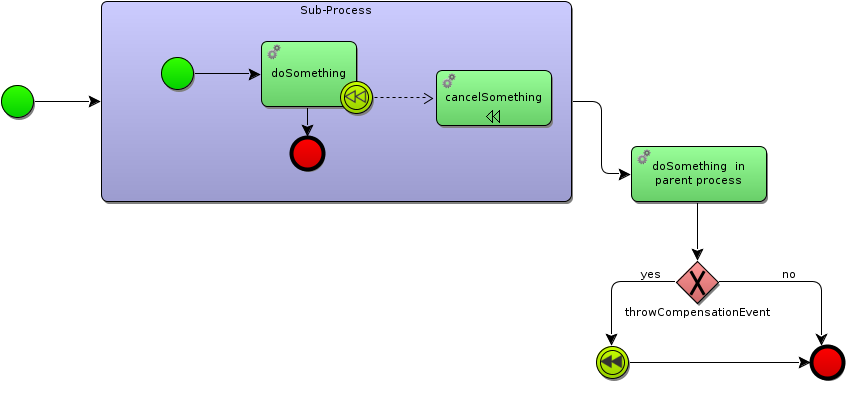
I have a process with an (embedded) SubProcess like this:
[attachment=2]SubProcessTest.png[/attachment]
If the parent process reaches the compensation-throw-event, the cancelSomething (compensation) service-task (of the sub-process) is executed as expected.
However, when I try to achieve the same with a CallActivity like this
parent-prozess:
[attachment=1]CallActivityWithCompensatingSubProcessTest.png[/attachment]
sub-process:
[attachment=0]SimpleProcessWithServiceTaskAndCompensation.png[/attachment]
in this case the "cancelSomething" (compensation) service-task is never called.
So, is this the expected behaviour? Or is there any alternative to achieve the desired functionality with CallActivities?
ty,
daniel
I have a process with an (embedded) SubProcess like this:
[attachment=2]SubProcessTest.png[/attachment]
If the parent process reaches the compensation-throw-event, the cancelSomething (compensation) service-task (of the sub-process) is executed as expected.
However, when I try to achieve the same with a CallActivity like this
parent-prozess:
[attachment=1]CallActivityWithCompensatingSubProcessTest.png[/attachment]
sub-process:
[attachment=0]SimpleProcessWithServiceTaskAndCompensation.png[/attachment]
in this case the "cancelSomething" (compensation) service-task is never called.
So, is this the expected behaviour? Or is there any alternative to achieve the desired functionality with CallActivities?
ty,
daniel
Labels:
- Labels:
-
Archive


3 REPLIES 3

Options
- Mark as New
- Bookmark
- Subscribe
- Mute
- Subscribe to RSS Feed
- Permalink
- Report Inappropriate Content
08-01-2012 02:43 PM
well, I am no expert but in my evaluation I found that compensating transaction works within subprocess scope only.
<transaction id="myTransaction" >
<subProcess id="subProcess">
…
</subprocess>
</transaction>
Could you try creating a subprocess and embedding call-activiti within it?
pdt
<transaction id="myTransaction" >
<subProcess id="subProcess">
…
</subprocess>
</transaction>
Could you try creating a subprocess and embedding call-activiti within it?
pdt
Options
- Mark as New
- Bookmark
- Subscribe
- Mute
- Subscribe to RSS Feed
- Permalink
- Report Inappropriate Content
08-02-2012 05:47 PM
hi,
yes I tried to put the callactivity inside a (transactional) subprocess but compensation does not work for the process called by callactiviy.
however this seems to be the expected behaviour (according to the bpm-specs chapter: 10.7 Compensation) - can someone confirm this?
yes I tried to put the callactivity inside a (transactional) subprocess but compensation does not work for the process called by callactiviy.
however this seems to be the expected behaviour (according to the bpm-specs chapter: 10.7 Compensation) - can someone confirm this?

Options
- Mark as New
- Bookmark
- Subscribe
- Mute
- Subscribe to RSS Feed
- Permalink
- Report Inappropriate Content
10-16-2013 02:42 AM
Hello,
I have the same problem here: a main process (compensateProcess.txt) has to be compensated after a callActivity (someProcess.txt) has returned. How can I trigger the compensation on the called activity ?
I start the main process using the REST api:
<code>
{"processDefinitionKey":"compensateProcess", "variables":[{"name": "successful", "value": false}]}
</code>
I get the following output:
<code>
First task
second task
hello
subprocess
compensate subprocess
compensate second task
compensate first task
</code>
the called activity outputs the "hello" line and should be compensated at some point. Note that the compensation works just fine with an embedded subprocess.
I have the same problem here: a main process (compensateProcess.txt) has to be compensated after a callActivity (someProcess.txt) has returned. How can I trigger the compensation on the called activity ?
I start the main process using the REST api:
<code>
{"processDefinitionKey":"compensateProcess", "variables":[{"name": "successful", "value": false}]}
</code>
I get the following output:
<code>
First task
second task
hello
subprocess
compensate subprocess
compensate second task
compensate first task
</code>
the called activity outputs the "hello" line and should be compensated at some point. Note that the compensation works just fine with an embedded subprocess.
someProcess.txt.zip
2 KB

Related Content
- Critical Issue with EventSubProcessMessageStartEventActivityBehavior in Alfresco Activiti Integratio in Alfresco Forum
- Can we add rate limit to a subprocess or an API in Activiri BPM in Alfresco Forum
- Activiti Workflow Builder- Intermediate Time catch events in Alfresco Forum
- Timer Boundary Event with condition in Alfresco Forum
- Activity Cloud 7.1 work fine but I can´t deploy a new bpmn20.xml in Alfresco Forum
Getting started
Tags
Find what you came for
We want to make your experience in Hyland Connect as valuable as possible, so we put together some helpful links.
